
Welcome and housekeeping (0:03)
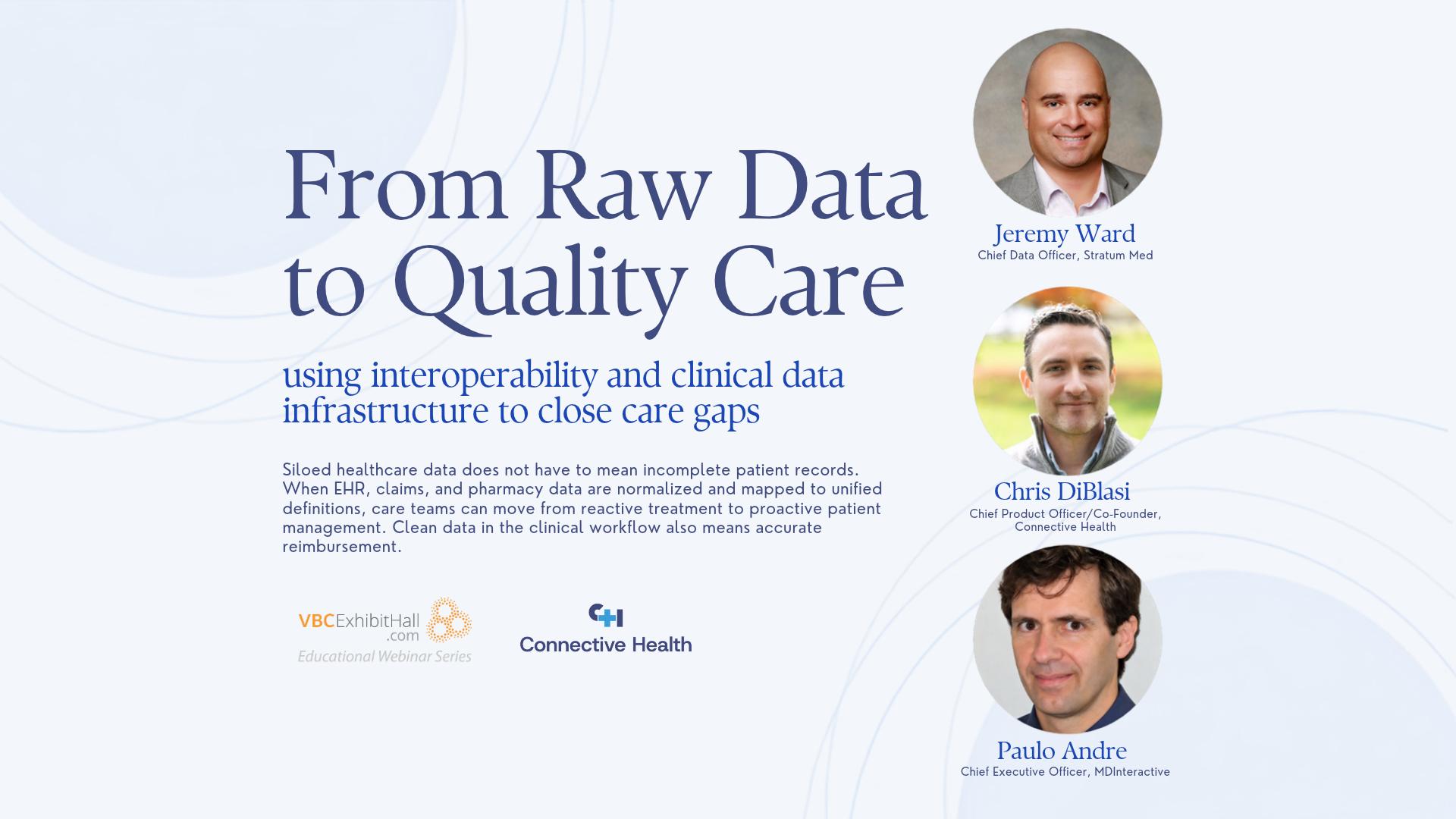
Garret Schmitt [0:03]: Hello, everybody. My name is Garret Schmitt, and I'm the CEO and managing editor of VBC Exhibit Hall. I'd like to welcome you all to today's live webinar hosted by Connective Health, with a few special guests we'll introduce in a moment. Today's session is called "From Raw Data to Quality Care: Using Interoperability and Clinical Data Infrastructure to Close Care Gaps." We have a lot of great information to cover, but first, a few housekeeping items.
Today we're in a traditional webinar format, which means we can't see or hear you out there in the audience. But we do want to hear from you, and we'll have time for Q&A toward the end of the presentation. If you have a question at any point, you can ask it using your control module, which has a special section just for questions. We're going to get to as many as we can. If we run out of time and can't get to yours, don't worry. Someone will reach out to you by email and get your question answered afterward.
The session is also being recorded. About an hour after we conclude, you'll receive an email with a link to today's session, the recording, and a place to download the slides. We think you'll want to do that, because there's a lot of great reference material, and you can share it with colleagues and friends as well.
Without further ado, I'd like to briefly introduce our speakers. With us we have Jeramey Ward, chief data officer with Stratum Med. We have Dr. Paulo Andre, chief executive officer of MD Interactive. And we have Chris DiBlasi, CPO and co-founder of Connective Health. Welcome, gentlemen. Chris, I believe you're going to kick us off.
Connective Health overview and the problem of incomplete data (2:10)
Chris DiBlasi [2:10]: Thanks, Garret. I appreciate the introduction. I think this will be an interesting conversation with a few experts here, so I thought we could begin with a quick overview of my company, Connective Health. As Garret mentioned, I'm one of the co-founders, and I run the product team.
We're an interoperability platform for providers. What does that mean? As a foundation, we give our customers, who are provider groups, access to their patients' outside medical records. What we found, working in depth with providers on the ground, is that access to outside medical records is not enough on its own. They need a curated view of those records. That view can differ depending on the provider's specialty, the patient they're seeing, the use case, and the clinical workflow they're in. Different pieces of the medical record matter in different scenarios. So we're an interoperability platform that goes the last mile, the extra mile, to curate access to medical records down to the very specific reason a provider needs them when treating a patient.
One more thing I'll add, and then I'd like to get Jeramey's and Dr. Andre's thoughts. Why is what I just described important? [Gap in source, about 4:10 to 5:22. The text resumes mid-sentence.] ...we found it's important to do what we do.
Jeramey, I was thinking of you and Dr. Andre, maybe Jeramey first, if you don't mind. Your background is as a data scientist, and you have quite a lot of experience dealing with EHR medical records and claims. I have two questions. First, would you agree that relying on just those is not giving you the full picture? And if you do agree, how have you dealt with it in your experience?
Jeramey Ward [5:50]: That's a good question. To start, I think this is highlighted perfectly well here: most organizations, at best, are operating off what I call two partial pictures, claims and maybe their internal EHR. The issue with just those two sources is that claims arrive late, and the EHR is fast but usually incomplete, with internal data teams at clinics and provider groups. The challenge is that no single source can answer what happened to this patient. The other interesting thing about these numbers is that this assumes the 70% of the data you do have is clean. We've all experienced the challenges of claims and even EHR data being clean. And I think the other piece, too, is... [Gap in source, about 6:32 to 7:48.]
What we've experienced at Stratum is being able to create one conformed grain for providers and patients. That helps us get at the source of truth around that particular patient. One of the things most organizations should strive for when they think about these data sources and their data strategy is treating claims, clinical data and HIE data, as we'll talk about with Chris and the team, as co-equal sources, instead of picking a favorite, which some organizations do. They pick claims as the source of truth, or something else. By not blending these data sets together, you generate blind spots that the Connective team is able to fill in. Those are my thoughts. Chris, I don't know if Dr. Andre has any different ones.
Chris DiBlasi [8:37]: Before you chime in, Dr. Andre, I know you wear a few different hats as a technology co-founder but also a practicing clinician. I'm interested in your thoughts across the board, but I was almost thinking about you as a provider. Is this a problem you encounter engaging patients yourself, and how do you navigate missing information? Take it wherever you want.
Dr. Paulo Andre [9:11]: As a neurologist in my practice, usually someone prepares the chart the day before the visit, but there are two difficult spots we can get into. One is the patient who comes in at the last minute and there's no information. Now I'm seeing a complex patient, and I have no idea what happened or what studies were done. The second is the opposite. A patient with a complex medical history comes with an encyclopedia of printed information, with lots of notes and repeated tests. As you know, many times in EHRs the notes are copies of each other. The doctor copies the notes from the previous visit, and they keep piling up. What I really need is to know: did the patient have the allergy, did they have a stroke or not, was an MRI done or not?
Connective Health fills both ends. For the patient where we don't have anything in the EHR, we can get data from all the other clinicians who saw the patient outside of our practice or system. For the patient where there is too much information, Connective Health uses AI to summarize the data, so we can make decisions fast without needing to read 500 pages of information.
Poll 1 and the sources of a complete picture (10:47)
Chris DiBlasi [10:47]: That makes sense. This might be a good point for the first poll. We've talked a lot about the fact that important medical information is missing and the impact of that, but I'm curious about the root cause. Why is information not in your EHR, or in a claim? You can see some of the most common answers I hear on the poll: seeing outside providers or specialists, perhaps the patient switched insurance, claims are missing or delayed so you don't have insight into what just happened. Across the audience, in your experience, why is information most commonly missing?
Garret Schmitt [11:46]: You should be seeing this on your screen now. For those of you just joining us, we're going to have a couple of interactive polls throughout the presentation, and this is the first. These are anonymous, by the way. This is just for fun, and we'll show you the results so you can see where you stack up among your colleagues. What is the most common reason for missing medical information? We'll give it another ten seconds or so and close it down. Okay, I'm going to close it in five, four, three, two, one. And if there's something we're missing, go ahead and drop it in the chat. We'd love to hear about it. Chris, are you able to see these results on your screen?
Chris DiBlasi [12:40]: Yes, I can see them on my screen. Can everyone see them yet?
Garret Schmitt [12:44]: Yes, everyone can see them at this point.
Chris DiBlasi [12:47]: I'm not surprised. The obvious one is when patients see an outside specialist, or really any outside provider. It's a crapshoot whether those records get back to the other providers who are also treating that patient. The most obvious example is a primary care physician. If you have a PCP and you're seeing outside specialists, you want to make sure your PCP is aware of what's going on with them. But really, for anyone treating anyone, if you're seeing multiple providers, it is definitely not reliably happening that all of them know what the others are doing. I'm curious what's in the "other" bucket. I see a few votes in the other category. If you want to put it in the chat, why else are providers missing information?
Garret Schmitt [13:45]: Someone chimed in and said the data is entered in the incorrect area of the chart, and the data is not properly interfaced.
Chris DiBlasi [13:53]: I don't think I can see the chat.
Garret Schmitt [13:55]: Yeah, you won't be able to see that from your view.
Chris DiBlasi [13:59]: Got it, no big deal. That makes total sense.
Jeramey, when you were opining on the last slide, I think you were teeing up this slide: going from an incomplete picture to a complete picture of the patient requires looking in other places. This is not an either/or. To get a complete picture of the patient, you need to look in all of these places. That's not only your internal EHR, but also claims, and also outside EHRs. As that poll suggested, outside EHRs are one of the most common root causes of missing information: other providers treating patients in EHRs that are not yours.
Then there are ADT networks. For folks who aren't aware, ADTs are alert pings from admitting and discharging hospital systems. They go out when patients are admitted, transferred or discharged. When people have activity in hospitals, there are alert networks that track those events, and you can hook into them. Proactive alerts when critical, acute things happen to patients are another pillar of the complete picture. The last couple of pieces are pharmacies and labs. Taken together, this is a pretty complete map of all the important places where medical information can reside that may or may not be communicated to everyone who needs to be in the loop. Jeramey, Dr. Andre, anything you'd add generally? It's okay if not.
Jeramey Ward [15:40]: The only thing I would add, piggybacking on what you just described, is that in my opinion this data set is probably the most complete healthcare data set you can create on any number of your patients in the United States. That's generally what I tell folks when I talk about this type of integration with these data sets. Some folks will bring up social determinants, and some data from credit information, things like that.
Chris DiBlasi [16:04]: That's a good point.
Jeramey Ward [16:05]: That has some influence, and it has gained a lot of traction in the last several years, with folks looking at SDOH. But outside of that, I think this is probably the most complete data set you can possibly get on a patient in the United States healthcare system.
Chris DiBlasi [16:28]: Anything you'd add, Dr. Andre?
Dr. Paulo Andre [16:31]: As CEO of MD Interactive, we work with over three dozen ACOs to report their data to Medicare, and right now many ACOs... [Gap in source, about 16:39 to 18:22.] ...breast cancer [unclear in captions], but then outside the skilled facility, and that really made a difference on the quality of care given to the patients.
Chris DiBlasi [18:31]: It's kind of obvious that providers are missing information on their patients, and I don't want to beat a dead horse. Generally speaking, SDOH probably should be on that slide, to be honest. But this would be the complete picture, and it introduces a new problem. Putting together all of these different sources into one place, for a complete picture, is just hard to do. That's one of the reasons it's not happening reliably today. It's not easy.
Deduplication, normalization and Poll 2 (19:24)
Chris DiBlasi [19:24]: To pull together the full picture across those different sources creates this new problem. As anyone who has tried to do this knows, there is massive duplication across medical records. And when you put them all together, that's not good enough. It has to be deduplicated. Different EHRs and different data systems use different terminology sets. They code things differently, and they categorize things differently. So not only deduplication, which is the first step, but also what we call normalization and augmentation. That means making sure diagnoses are coded as ICD-10, perhaps SNOMED, that your lab results are encoded by LOINC, and that medications use NDC or RxNorm. These are all industry-standard methods of consistently coding data on the back end. Not all source systems code things the same way, so there has to be a normalization layer to put them into the same place.
The third thing is that in many cases the data is unlabeled, or there are no good industry terminology sets. For cases where you're looking to encode and categorize things that are not otherwise categorized, that has to be done as well. So all of the work that goes into pulling from multiple outside sources and putting it into one place has to be done if you're going to put together a full picture of the patient.
Jeramey, I know this is your bread and butter as a chief data scientist for a data organization. Would you say organizations typically understand this and do it well, or not? What's your experience?
Jeramey Ward [21:29]: I think this is a massive engineering problem for most organizations, and I'll extend it even further. In the past I've taken ACOs, large physician groups and multispecialty groups through the process of connecting into some of these HIEs, like Connective does, and some of the sources we saw on that previous screen. Anybody can do it. Anybody can become an implementer on an HIE network. But to become an implementer, you have to be able to do all of these things that Chris just... [Gap in source, about 22:00 to 23:36.]
Dr. Paulo Andre (apparent) [23:36]: ...information that can appear in duplicate, triplicate, every possible variation. And the physician doesn't have time to review 75 charts and see what the last A1C is. They want a quick response. That's one thing Connective Health does well. For example, when we get a quality report summary, they just bring the latest data after removing all those duplicates.
Jeramey Ward (apparent) [24:04]: Yeah, Dr. Andre, my favorite is local lab codes. That's my favorite on ours. It's millions at this point, just the ones I work with. It's amazing.
Chris DiBlasi [24:17]: I think this would be a good point for the next poll.
Garret Schmitt [24:28]: All right, let's pull that up here. There we go. Chris, I'll let you introduce it.
Chris DiBlasi [24:41]: I am curious about this. I think I know what the results will end up being, though I'll be interested to see if I'm surprised. In my experience, some organizations do a good job of this, but a lot of them don't, for a variety of reasons. One is that it's an extremely complex landscape, and some organizations don't even know where to start. Another, as Jeramey was saying, is that it's a non-trivial, very material engineering problem, coupled with heavy clinical input needed along the way to do it right. It's cross-stakeholder, and it requires resources that organizations don't always have: engineering, but also allocated time from the clinical side to work side by side with engineering to solve the problem. A lot of organizations just don't have those resources.
Garret Schmitt [25:44]: Folks are still voting, but it looks like most people have submitted their answers. I'm going to close it down in five, four, three. Well, people are still coming in, so I don't want to close anyone off. Again, the question is: in your experience, how many organizations are able to pull together a complete picture of their patients? A small minority of organizations, some organizations, or most organizations? I'm going to close it down in five, four, three, two, one. There we go. Chris, are you able to see those results on your screen?
Chris DiBlasi [26:24]: Yeah, I can see it. I thought it would be split between small minority and some. It's heavier on the small minority than I thought. I expected it to be sort of 50-50 between small minority and some. Organizations with more resources have more bandwidth to throw at this problem, and it is a problem that requires quite a lot of bandwidth. Smaller organizations might not have it, because it is a non-trivial engineering problem plus a heavy clinical input problem to solve.
Clinical curation example: heart failure (27:05)
Chris DiBlasi [27:05]: Okay, we can go to the next slide. We've talked through the problem, which is missing medical information, and what the solution looks like: what a full picture of the patient looks like, and why that's hard to do. For the next five or ten minutes, I want to talk about the final layer, which goes beyond filling in the gaps and putting everything into one longitudinal record. The premise of our company is that yes, you need access to outside medical information, because providers can't be missing important information on their patients. But that creates new problems once you have access to outside medical records. The new problem is how you filter through the noise. How do you curate thousands of pages of records down to the things the provider needs to know? When we talk about that concept, it's not always clear what we mean, so I thought we could talk through an example.
Dr. Andre, a heads-up: I know cardiology is not your specialty, but I'd be interested in your clinical lens in a minute or two. Say you're treating heart failure. You're a cardiologist or a primary care physician, and you're checking in on your patient's heart failure. Heart failure, by the way, is a very important chronic condition in value-based care, given its prevalence and the hospitalizations it leads to, which are a significant cost driver. So it's very important to be on top of all of the heart-failure-related medical system interactions a patient has. What does that mean? If you're applying a clinical curation layer on top of all of these records, there are five things you need to know.
First, what specific heart failure diagnosis do they have? Translating that into the data, you're looking at ICD-10 codes, ideally, the I codes that begin with I9, I11, I13, [unclear in captions], and so on. We're looking for which specific diagnosis codes exist in the medical records that indicate what form of heart failure they have, preserved ejection fraction, reduced ejection fraction and so on. Those are different heart failure diagnoses.
Second, any recent cardiac imaging, by which I mean echocardiograms, cardiac caths, Lexiscans, imaging of the heart in general. Probably the most important piece is their most recent few echocardiograms, which give you the underlying detail behind that heart failure diagnosis. By the way, identifying and surfacing cardiac imaging is also not a trivial engineering problem. It's often unstructured free text that has to be identified. So you're looking for abnormal cardiac imaging.
Third, since you're checking in on your patient's heart failure, you want to see whether they have seen a cardiologist recently and what's in those notes. You're looking through cardiology notes for heart-failure-relevant symptoms like shortness of breath.
I'll stop in a second and turn to Dr. Andre, but for the full picture you also want to see certain labs. There's a lot of lab data out there, but for heart failure you're looking at whether their BNP was elevated. That's another indicator of heart failure. And lastly, medications are a method of treatment, a treatment option for heart failure. So... [Gap in source, about 31:20 to 32:39.]
Dr. Paulo Andre (apparent) [32:39]: ...there, and we have a patient with symptoms that we need to treat. Having access to the entire United States, all the information from all the places where the patient went, can give us a complete picture so we can make decisions. Patients may not know the medications they are taking. Unfortunately, they go to a physician and there's always a new medication coming. Everyone can add medications, but nobody removes medications, and sometimes it's just the patients removing medications themselves.
When you open a summary note from Connective Health, you can see a list of all the medications and which doctors prescribed them, and you can review them. I was doing this with a patient recently who had about 15 different medications for so many problems. I asked, are you taking this? She said, no, I got that, but I didn't feel well in the first two days, so I stopped it. Now you can summarize it, and you know where you're going. You can know what interactions exist, which new medication you can add, and what your baseline is, so you have a reference point.
This is complex work, especially in heart failure. If you have the wrong medications, your lungs can fill with fluid, and a tiny adjustment to a medication can make a difference. It's not enough to know the medication; you need to know the dose. If the patient is doing well, you want to keep the dose. If the patient is not doing well, you want to increase it, but you need to know the baseline the patient is taking and what the last doctor gave. That is very important and makes a difference in the treatment of patients.
Chris DiBlasi [34:30]: That makes sense. Jeramey, from your standpoint, any thoughts or lessons learned? The important medical information for heart failure is not a mystery publicly. It's medical best practice. But translating that to data is not easy. How do you categorize and ensure you're finding the right things amongst the sea of information? They just want to treat heart failure, so "find me heart-failure-relevant information only" is not easy, data-wise.
Jeramey Ward [35:09]: I think this slide illustrates that, but it also makes it look very simple. We have five buckets on the slide. "Oh, I'll just get ICD-10 codes out of a claim" is a great example. But cardiac imaging, I can't get that unless I'm connected to an HIE that's connected to those EHRs. Same with notes, lab values and medications. All the same, outside of that first bucket. So this probably oversimplifies things. For one disease state, if I have these five sources of information, I can reasonably diagnose that patient with heart failure, instead of having to go find all this information or have the patient tell me, like Dr. Andre was alluding to. First and foremost, this really simplifies the data challenge of going out to get this data.
What Connective does extremely well, and what is really their bread and butter in my opinion, is taking these five macro sources in this example and distilling all of that down into the things a provider needs to know. One thing I didn't mention earlier is that you have to be able to take this information to the provider. I'm obviously a data person, chief data officer, heavy in AI and data science and all those good things. But one thing I know from tons of experience in this space is that if this information is sitting in a portal, or somewhere that's not in front of the provider, it's likely not going to get very far. So one of the last things I would mention is having this type of information distilled down, but pushed to the closest spot at the point of care that you can. What better place than smack dab in the EHR, like Dr. Andre was talking about with the care summaries Connective is able to produce? Having that at the point of care is, to me, the nirvana of all of this.
Point-of-care examples and Poll 3 (37:00)
Chris DiBlasi [37:00]: That's a good point. It teases out the next slide pretty well. We'll probably have a webinar on this topic alone at some point: putting everything we're talking about together, then delivering and presenting it at the point of care, within the clinical system. That might be an EHR, a population health platform, or who knows what. There are a lot of different clinical systems out there, mostly EHRs, and there are various ways to do that and most effective ways, and so on.
These are just screenshots showing a couple of other examples of how we pull it all together. The example on the left is a quality measure for blood pressure control for diabetics. It collects a patient's recent blood pressure readings from a variety of different sources and puts them into one place for someone who is prepping a chart or going back over a patient's care quality performance. The example on the right is a preventive screening summary showing a recent colorectal screening. These are other use cases, and other lenses, through which curated access to outside medical records can be applied to clinical workflows. Quality gap closure is another example. It's most impactful when it's delivered in workflow, ideally within the clinical system, like an EHR. There are a variety of ways to do that, but the point is that it has to be there some way or another.
This would be a good point to pause for what I think is our last poll. Having easy access to your patients' outside medical records can be used in an infinite number of ways, but I'm curious about the most common treatment workflows. From our standpoint, we usually see one of a few that are most commonly helped by access to outside medical records. We put a few in the poll. I'm sure we didn't get them all right, but we put the top ones we tend to see. After listening to all of this, where does the audience see the highest-impact areas?
Garret Schmitt [40:07]: As Chris mentioned, this is the last poll we're having this afternoon, so go ahead and put your answers in. What are the most common treatment workflows impacted by missing medical records? Chart prep, prospective risk adjustment, closing gaps in care, ongoing care management, hospital discharge follow-up, or other. Let us know in the chat. I'm sorry in advance that you only have to pick one, because I'm sure some of you are wrestling with that decision, too.
Chris DiBlasi [40:42]: I was just thinking the same thing. Multi-select would have been nice.
Garret Schmitt [40:46]: Maybe next time we'll do that. In hindsight. All right, we're going to close it down in another five long seconds and then show the results here. Five, four, three, two, one.
Chris DiBlasi [41:05]: This was an interesting one. I'm actually surprised by it. In our experience, all of these workflows are helped by access to outside medical records. These are the four that we put in there because they're the four most common that we encounter. I'm really surprised that prospective risk adjustment isn't higher. Maybe it wasn't clear. Chart prep and risk adjustment usually lead our conversations: if you're prepping for an upcoming patient, it's important to accurately document their chronic conditions for risk adjustment. So I'm surprised that one is low. Ongoing chronic care management and closing gaps in care are kind of no-brainers. We deal with those a lot with customers. Hospital discharge follow-up means having access to the discharge note, the discharge summary, the hospital course summary note at the point of discharge, when you're trying to re-engage patients for follow-up. That's another common one. There were no others, so maybe those are truly the top four. Any reactions, Jeramey, Dr. Andre, before we move to the last slide?
Dr. Paulo Andre [42:16]: In my personal experience, hospital discharge and transitions of care are one of the most dangerous moments in a patient's life. They spend a few days in the hospital, decisions were made, they are overwhelmed, and suddenly they go back to the physician. If you don't get what happened in the hospital and what the last medications were, there is a high risk of losing the benefit of the admission. The conclusions reached about how to treat the patient can be lost, and that causes lots of problems. So for me, that's one of the more important ones.
Jeramey Ward [42:58]: Yeah, I agree. Transition care management, TCM, is an important lever in value-based care, so I'm not surprised that one blipped on here. I do agree with you, Chris, on risk adjustment and chart prep. Those two are definitely hampered when you don't have outside medical records. It might be that you can do chart prep with what you have, and the same with prospective risk adjustment. So maybe that's where some of the faults are there.
Closing the loop (43:26)
Chris DiBlasi [43:26]: All right, we can go to the last slide. To me this is the capstone. It's probably obvious, but when you put together all the pieces in the ways we've just talked through over the last 45 minutes, we call the last step "closing the loop." When you have the full picture, closing the loop becomes much more impactful. By closing the loop, we mean closing the loop with a provider who's prepping to see a patient, and closing the loop between the provider and the patient. And, while it's not the primary purpose of our service and our product, or of this conversation, closing the loop with the payer. If you don't get paid for the work... [Gap in source, about 44:17 to 45:43.]
Dr. Paulo Andre (apparent) [45:43]: ...your patients. This is not the primary focus for Connective and for this data, but it's a secondary benefit of doing this at scale. With Connective Health, you can get this data as a PDF in the hands of the physician at the point of care. When you need the summary for patient Jane Doe at that moment, you can get it as fast as possible. But you can also connect to Connective Health with an interface, an API, and do this at scale. You can find, across all of your patients at the ACO, who is missing care, and whether that care was already given by an outside physician.
Then we send that information back to each individual physician, so they can call the patients and make extra appointments. If a breast cancer screening is missing, they can order that test because it was not done outside, instead of someone else having already done the study. You don't want to be calling the patient asking them to do the test again, because it always feels bad. The patient says, "You should know what happened with me. What kind of doctor are you that you have no idea what happened with me? I told you before." So this helps the patients, it helps the clinicians do a better job, and at the level of population health it makes a big difference in improving the care of the entire population at scale.
Chris DiBlasi [47:17]: Another interesting aspect we've noticed is the interaction between claims and medical records. Most of the time they align. What is documented in a medical record aligns with the downstream claims, but that's not always the case. Again, it's not the primary purpose of the service here, but it has been interesting to see firsthand where claims and medical records do or don't align, and why, and there are real reimbursement implications there. Jeramey, any final thoughts on that before we close up for Q&A?
Jeramey Ward [48:04]: No, I'll just highlight what Dr. Andre said at the end. One of the things we do with this data, through connectivity to the data source itself, and not just what's delivered at the point of care, is have much more accurate real-time reporting. We can generate operational efficiencies, like Dr. Andre said, such as not reaching out to a patient who already has something done, or not bringing patients into the office to close gaps that have already been closed. Those are tiny little levers.
Every clinic has reporting: quality reporting, HEDIS reporting, all that good stuff in value-based care. But it's living off data that is in arrears if you're connected to claims, and siloed to just your practice if you're connected only to the EHR. Bringing in this data set from a reporting and analytics standpoint allows us to be much more real time with what we're able to show the providers and the care teams. That creates a lot of efficiencies, quite honestly.
Audience Q&A and close (49:06)
Chris DiBlasi [49:07]: Garret, I think we're ready for Q&A if you are.
Garret Schmitt [49:13]: Yeah, we do have a number of audience questions. If you have a question you would like to ask Dr. Andre, Jeramey or Chris, now is the time. There's a specific place for questions in your module. We're going to get started in no particular order. The first question is this: practically speaking, how would this work if my organization already has an EHR and/or claims feed set up? Where would this fit in?
Chris DiBlasi [49:44]: That's what our implementation process addresses, so that is a good question. When we work with our clients, who are provider groups, they obviously have an EHR. Some of them have claims feeds and some do not. But that's always the first question: this is sort of a new idea, so where does it fit? In case it's not obvious, none of what we're saying is ever a replacement. Jeramey, you said this earlier. We're not talking about replacing anything. We're talking about augmenting what you have, which is your EHR or claims feeds.
The data connections are already there. The pipes have already been built to all of these different data sources. What we do is first understand what type of provider you are. Are you a cardiology practice? Are you a PCP? Are you participating in value-based care or not? Are you an ACO? Then we fine-tune: what types of medical records are most important to you, and what's not important to you, so we can curate away the noise. Once we have a picture of what's important to you, we configure the product to focus on that, and we integrate it into your workflow, alongside what you're already doing. To be tactical about it, there might be something new that pops up in a provider's EHR, so there is training around what this new thing is. But everything we do is designed to be inside the clinical workflow and to augment what you have today.
I'll give one more very specific answer, which is: what are the sources? We connect to Carequality, CommonWell and eHealth Exchange, which are our national EHR data exchanges. The whole industry is moving toward a new framework for that, which is QHINs, for those in the data world who know what I mean. We also connect to Surescripts, which has a nationwide pharmacy pickup feed. We use PointClickCare and Bamboo Health, which are two ADT hospital alert vendors. To top it off, we pull in lab feeds from Labcorp, and we also connect to some state and regional HIEs. So it's a variety of different data sources, pulled together and curated in the ways we talked about before, and woven into an existing clinical workflow in a way that makes sense for the provider.
Garret Schmitt [52:59]: The next question is this: how do you engage payers to share data electronically with your practice? We still see a lot of old-fashioned Excel sheets.
Chris DiBlasi [53:10]: Dr. Andre, this might be right in your wheelhouse.
Dr. Paulo Andre [53:17]: We work with several ACOs, so there's still lots of Excel going back and forth. Medicare is pushing for the plans to move to the FHIR level to share data, but most players are not there yet. One thing we have been seeing in some of our ACOs is that they were able to contact multiple payers and come up with an agreement to at least share the same Excel file to send data back. Our registry collects all-payer data as part of the Medicare reporting, and we send back to the ACO a file that tells each payer, United, Harvard Pilgrim, Blue Cross, these are the A1C values. Some ACOs have been able to convince the payers to accept the same format. Eventually this will switch to the FHIR level, and maybe even the payers will be able to integrate into the network and find data from other sources. But it's still a lot of manual process. ACO staff need to review it, and every time a payer changes the format, there's a new Excel and everything stops working. This is the beauty of moving to a platform that is open, where every source of information can be shared securely. Something like Connective Health.
Chris DiBlasi [55:00]: To connect the dots back to that, feeding into that platform, or feeding into those spreadsheets, but ideally a platform, is data from a few places, including Connective Health. The role Connective plays is upstream, before it ever gets to the reporting phase. You're treating and engaging patients, and monitoring your patients, with the benefit of access to medical records from Connective Health. The data from Connective Health flows into your clinical systems, and then downstream it flows into these sometimes spreadsheets, but ideally more of a platform that then gets reported back to payers.
Garret Schmitt [55:55]: Moving along, this is an interesting question, a multi-part one, but let me see if this makes sense for you. Have you addressed the copy-paste practice? It is overwhelming records and impacts risk adjustment, patient care and billing. Additionally, CMS is calling it out as a significant finding in chart review. This is a foundational issue, and I'm hoping you can address it.
Chris DiBlasi [56:20]: 100%. In my role as head of product at Connective Health, I'm knee-deep in medical records every day, and I definitely see a lot of what you mean. There's massive duplication across medical records, and one of the causes is clinical notes. If someone has been hospitalized and has daily check-ins from different providers, there are daily progress notes. Across healthcare, pasting the prior note into your current note and adding on top, or in some cases not even adding anything on top, just pasting and that's it, happens very frequently.
I'd say two things. One, deduplication across medical records is a key component of what we do. Our goal is to boil it down to a curated, longitudinal "here's what you need to know about your patient and nothing that you don't need to know." That's the vision. So deduplication, including repeat notes, is for sure an important part of what we do. The other thing I'd say is that it's a challenging problem, maybe obviously. Deduplicating two notes that are usually not exactly the same, but may have an extra sentence added at the end or the beginning, or different punctuation, where a large chunk is copy-pasted, is non-trivial to solve. But deduplication, including of notes, is a key component of what we do.
Dr. Paulo Andre [58:14]: And you see it a lot. It makes a huge difference. For example, now you cannot just send a huge 700 pages to AI to help you analyze. Connective Health summarizes the notes. If you use OpenEvidence, you can ask for advice, but OpenEvidence has limits on the amount of information you can put in. You don't want to send 700 records. You want a one- or two-page PDF summary, and then OpenEvidence or another AI can give you feedback. So this is a very important function.
Chris DiBlasi [58:49]: You mentioned AI, and I would add that identifying two notes that are duplicates when they're not exactly character for character the same is, again, very hard to do. AI, and the recent advances in its effectiveness, have helped us do that more, for sure.
Garret Schmitt [59:11]: Very good. Well, unfortunately, we are out of time. I wanted to thank you all. I know there are a number of questions we weren't able to get to. Don't worry, someone will make sure to reach out and answer your question, so if you have one even now, go ahead and submit it and someone will get back to you. Thank you, Jeramey, thank you, Dr. Andre, thank you, Chris, for a fantastic and very thorough presentation.
As we close out, I want to encourage you all to head over to VBC Exhibit Hall and check out the Connective Health virtual exhibit booth. There will be a direct link in the slides you can download, and there are a lot of great resources if you want to take a deeper dive into what they're doing. You can also reach out to them there. If you would like to reach out directly to the Connective Health team, their information is on this final slide. You've got Ryan, Shane and David, who are all wonderful and will steer you in the right direction. Or, if you would like, I'm happy to facilitate an introduction if you want to reach out to me directly. I want to thank you again for spending your afternoon with us. I hope you enjoy today's session and will join us on the next one. Until then, have a great rest of your day. Bye bye.
Chris DiBlasi [1:00:34]: Thank you.